
📍 7 stops · ⏱ ~7 h
We walk the cobbled heart of Leuven from the masterpieces inside M – Museum Leuven to the soaring Gothic of St. Peter's, then through the Grote Markt and Oude Markt before the evening singalong of Leuven Zingt, closing in the quiet green of the city's two best gardens.
Want your own personalized plan for free?
is the wide, bright square that sets the tone for the city's intellectual life. The tower rises at one end — a rebuild from the 1920s, paid for by American donations after the original was burned in 1914. The carillon plays on the hour, and the square fills with students and bicycles, a living postcard of what Leuven actually is.
occupies a striking building by the Belgian architect Stéphane Beel, opened in 2009, which wraps around an inner garden and a 16th-century house. The permanent collection traces the story of visual culture in this region from the Middle Ages through the 19th century, with a strong showing of late-Gothic sculpture and Flemish Primitive painting. Temporary exhibitions draw on contemporary art and design, and the rooftop gives a clean view over the city's spires.
Things to do nearby Leuven: Echoes of History Audio Tour
WeGoTrip
from €10
Leuven: Echoes of History Audio Tour
WeGoTrip
from €10
The inner courtyard garden is free to enter even without a museum ticket — a quiet stone-and-green pocket that most visitors walk straight past. Grab a coffee at the museum café and sit here for ten minutes before heading back into the galleries.
Weekends get busy by early afternoon — a morning entry means quieter galleries and time to linger in front of the panels without a crowd.
St. Peter's Church sits at the top of the like a stone ship, its western towers truncated at half their intended height — the original 15th-century plans proved too ambitious for the soft ground. The exterior is a textbook of Brabantine Gothic, but step inside and the real treasure reveals itself: the Flemish Primitives. The church holds ' 'The Last Supper' (1464–1468), a triptych commissioned by the Confraternity of the Holy Sacrament, and his 'Martyrdom of St. Erasmus', both still hanging in their original location.
Entry to the church is free, and the interior is a soaring, light-filled space of white stone and slender columns. The paintings are the main reason to come — 'The Last Supper' is displayed in a climate-controlled chapel to the right of the choir, with a small treasury of silver and liturgical objects nearby. Look up at the intricate stone vaulting and the 16th-century rood screen, one of the finest in Belgium.
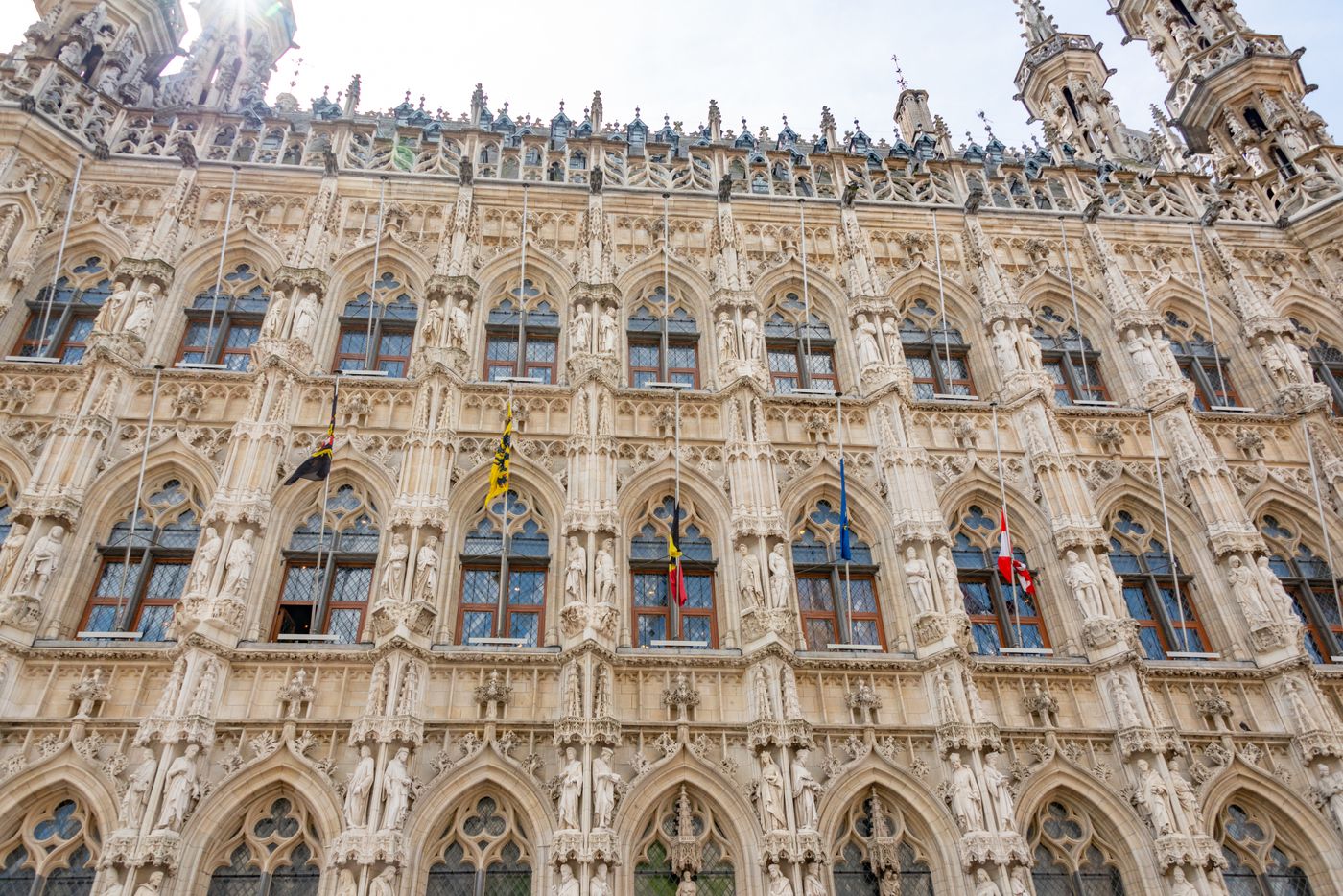
St. Peter's Church · Book onlineGetYourGuideThe is the city's main square and one of the most concentrated displays of Gothic civic architecture in the Low Countries. The , built between 1439 and 1469, is the star — its facade carries 236 carved figures in niches, added in the 19th century, representing saints, scholars and local worthies. Opposite, the round Tafelrond building (1920s neo-Gothic) and a ring of step-gabled guildhalls complete the scene. On a Saturday morning the square hums with a market, but even on a quiet weekday the sheer sculptural density of the place rewards a slow walk around its perimeter.
On the side wall of the , facing the church, a set of iron bars and carved stone markers show the official medieval measures of length — the Leuven 'el' and 'roede'. These were the standards against which market traders' cloth and timber were checked. They sit quietly in plain sight, and almost nobody stops to read them.
A free, low-key writing session held at the wereldcafe coop — a community-run café and meeting space just south of the centre. Bring a notebook or laptop, order a coffee, and settle into an hour of quiet, focused writing alongside a handful of locals. No critique, no reading aloud — just shared, productive silence. Free entry, walk-in welcome.
Shut Up & Write! Leuven · Event pageshutupwrite.comWereldcafe coop is part of a network of fair-trade, volunteer-run cafés across Belgium. The coffee is ethically sourced and the space doubles as a small cultural venue — check the noticeboard by the door for local gigs, language exchanges and film nights that rarely appear online.
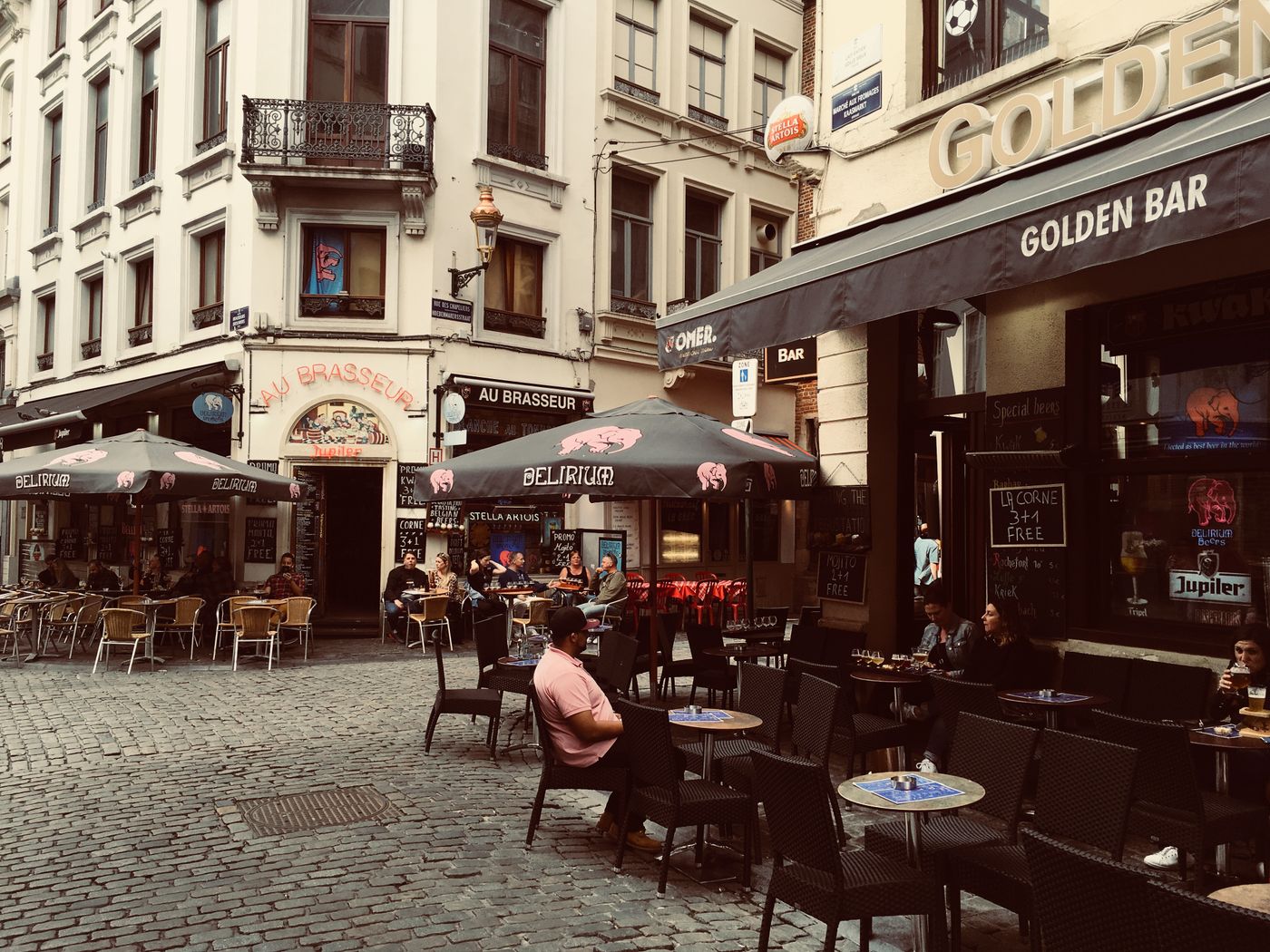
The is a long rectangular square ringed by more than forty cafés and bars — locals call it 'the longest bar in the world'. By day it is a relaxed lunch spot with terraces catching the afternoon sun; by night it transforms into the city's main social hub. Grab a table at one of the brasseries, order a local beer and a plate of stoofvlees, and watch the square's rhythm shift as the afternoon wears on. Leuven Zingt is the city's great summer singalong — part of the Het Groot Verlof festival. A live band leads the crowd through a set of Dutch, French and English classics, and the whole square joins in. Free entry, walk-in welcome — arrive early to claim a spot near the stage or grab a drink at one of the surrounding cafés and sing from the terrace.
Sint-Donatuspark, known locally as Het Stadspark, is a small, sloping green space laid out in the 19th century on the site of the old city fortifications. Fragments of the 12th-century stone ring wall still run along its eastern edge, half-swallowed by ivy and trees. The park climbs a gentle hill to a terrace with a view back over the rooftops of the centre — a good spot to sit on a bench and let the afternoon settle.
The Kruidtuin is the oldest botanical garden in Belgium, founded in 1738 by the university as a herb garden for medical students. Today it is a free, open collection of more than eight hundred plant species arranged across a terraced site — formal parterres, a small orangery, a pond with a weeping willow, and a greenhouse of tropical specimens. The garden is at its best in late afternoon, when the light filters through the old trees and the students have gone home. Open year-round, free entry.
The small tropical greenhouse at the back of the garden is easy to miss — follow the path past the pond and look for the glass door on the right. Inside, the humidity hits you first, then the smell of damp earth and flowering orchids. It is a complete sensory shift from the formal beds outside.
The back streets between Sint-Donatuspark and the Kruidtuin are a tangle of small lanes and shortcuts — it is the kind of five-minute walk where you glance at your phone once to check the turn, then put it away. Having a little data on hand means you do not second-guess the route and can just walk.
Get an eSIMAiralo
 makes a personal plan in one tap. Tune it by mood, diet, time, budget, squad — and drop in your own places. Works in 65,000+ cities. It learns what you like, so every next plan fits better. Stop Searching. Start going.
Sources give mixed signals about this spot — we recommend confirming before visiting.
Tap outside to close
Tap outside to close
 squad
squad like
like