
📍 8 stops · ⏱ ~17 h

We trace Hamburg's alternative heart from a community street festival in Eimsbüttel through the flea markets and punk history of the Schanzenviertel, into the raw club culture of St. Pauli — a full-day dive into the city's activist, musical, and countercultural roots.
Want your own personalized plan for free?
We start the day on Else-Rauch-Platz, a leafy square surrounded by the handsome Altbau facades that define this family-friendly district. The Methfesselfest has been running here for over fifty years — a local institution where neighbours set up stages, food stalls, and workshop tents. The vibe is relaxed and community-driven, the exact opposite of a commercial fair.
The 53rd edition of this beloved street festival fills the square with live music across several small stages, street food from local kitchens, and open workshops. Discussion rounds and community info stalls give it a distinctly grassroots, political flavour — this is where the neighbourhood comes to talk, eat, and dance together.
Methfesselfest · Event pagefacebook.comThe Methfesselfest is named after the Methfesselstraße that borders the square. It started in the 1970s as a small local initiative and has grown into a fixture of 's summer calendar. The workshops and discussion rounds reflect the district's long tradition of tenant activism and community organising — it is a party with a political conscience.
Schulterblatt is the spine of the Schanzenviertel — a broad, tree-lined street that mixes kebab shops, left-wing bookstores, vintage clothing racks, and the constant hum of bicycle traffic. The neighbourhood has been Hamburg's countercultural nerve centre since the 1980s squatter movement, and the street art layered on every available wall tells that story in spray paint.
Every Saturday morning, the stretch of Schulterblatt nearest the fills with trestle tables and blankets piled with second-hand clothes, vinyl records, old cameras, and the kind of bric-a-brac that rewards patient digging. Locals browse alongside students and artists — it is as much a social ritual as a shopping trip.
Schulterblatt Flea Market · Event pagefacebook.comThe is a former theatre turned occupied social centre, and the symbolic heart of Hamburg's radical left. Since the late 1980s, it has been a self-organised space hosting concerts, political meetings, a café, and a community garden. The building itself is a defiant splash of graffiti and banners — you cannot miss it, and you cannot separate it from the identity of the Schanzenviertel.
Rote Flora · Book onlineGetYourGuideA tiny sandwich deli that opened recently in the Karoviertel, Ouf has quickly become a local favourite for its creative, ever-changing combinations — think roast beef with pickled walnuts or grilled aubergine with harissa yoghurt. The space is small, the queue often spills onto the pavement, and the whole operation runs on a cheerful, no-fuss energy that feels very much of this neighbourhood.
Away from the neon of the main strip, the side streets north of the have a different rhythm — vintage clothing racks on the pavement, record shops, and bars that look closed but whose doors are propped open for afternoon regulars. This is 's daytime face, quieter but no less characterful.
The streets around the are dense with vintage and second-hand shops — a mix of carefully curated boutiques and chaotic kilo-sale warehouses. The selection reflects the neighbourhood's punk and alternative roots: leather jackets, band tees, 1970s denim, and the occasional designer piece that slipped through the cracks. Browsing here is a slow, rewarding ramble.
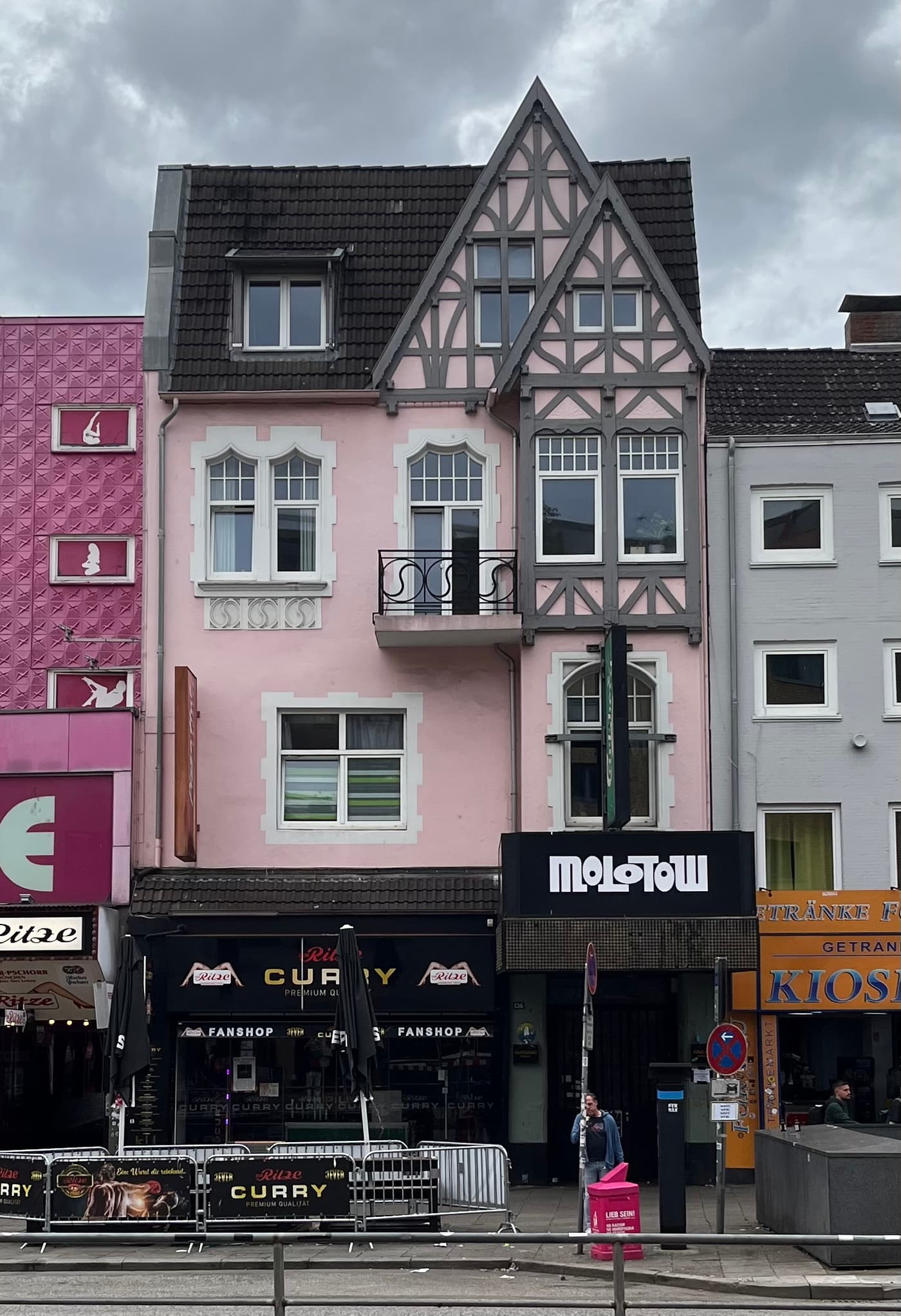
is a legendary dive bar and music venue on the , a cornerstone of Hamburg's indie and alternative scene since the 1990s. The walls are plastered with stickers and band posters, the beer is cheap, and the jukebox leans heavily into punk, garage rock, and lo-fi. During the day it is a low-key spot for a drink and a breather; by night, it transforms into a sweaty, loud, and essential live room.
Molotow · Book onlinelivenation.deAs we move away from the neon core, the streets grow wider and the buildings more utilitarian — warehouses, workshops, and the kind of unmarked doors that lead to some of Hamburg's best electronic music. This is where the city's rave roots run deepest, in converted industrial spaces that have hosted after-hours parties for decades.
is a raw, industrial venue on the edge of that has become a focal point for Hamburg's electronic underground. Tonight's open-air rave kicks off at 7 PM and runs deep into the night — expect a lineup of local DJs, a no-frills sound system, and a crowd that comes for the music, not the décor. Tickets are required and should be booked in advance.
Open Air Rave at 25 Club · Ticketsvividseats.comHafenklang sits in a former harbour warehouse on the Elbe, its windows looking out onto the water. For over thirty years, it has been a pillar of Hamburg's alternative scene — a club, bar, and cultural space that has hosted everyone from punk bands to experimental electronic acts. The sound system is excellent, the programming is unpredictable, and the crowd is a loyal mix of old-school regulars and curious newcomers. It is the perfect place to let the night settle in.
Hafenklang often announces surprise sets and last-minute line-up changes on their social channels — having a bit of data on your phone means you can check what is happening in the back room without leaving the main floor.
Get an eSIMAiraloIf you have been carrying a daypack since the morning market, there is a luggage storage point near the where you can leave it for a few hours. Walking into a packed club hands-free is a small liberation.
Store your bagsRadical Storage
 makes a personal plan in one tap. Tune it by mood, diet, time, budget, squad — and drop in your own places. Works in 65,000+ cities. It learns what you like, so every next plan fits better. Stop Searching. Start going.
Sources give mixed signals about this spot — we recommend confirming before visiting.
Tap outside to close
Tap outside to close
 squad
squad like
like