
📍 8 stops · ⏱ ~10.5 h

We spend Independence Day deep in the historic core, starting with the museums and market stalls of El Pueblo before settling into LA Plaza for the Mexico Round of 32 match — then the afternoon unwinds through a hidden adobe, a rooftop brewery, and a twilight park before a final contemporary art stop. It's a full, walkable day that moves from the city's oldest street to its newest cultural institutions, all within a few blocks.
Want your own personalized plan for free?
The morning begins in the historic birthplace of the city, where forty-four settlers of Native American, African, and European heritage founded a farming community in 1781. The narrow, brick-paved lane of is already alive with the smell of fresh churros and the sound of mariachi drifting from the plaza. This is the oldest surviving residential district in Los Angeles, and on a World Cup match day the energy is electric — families in green jerseys, vendors selling flags, and the hum of anticipation building as kickoff approaches.
The museum and cultural center dedicated to the Mexican and Mexican-American experience in Los Angeles. The permanent exhibits trace the layered history of the region — from the original Tongva inhabitants through the Spanish and Mexican periods to the present day — with photographs, artifacts, and oral histories that bring the story of the city's roots up close. On July 4th the courtyard transforms into a World Cup viewing party, with the Mexico Round of 32 match screened live; the crowd spills across the outdoor steps and the museum's garden, making it one of the most vivid places in the city to watch the game.
LA Plaza de Cultura y Artes · Book onlinelapca.org Things to do nearby Real Los Angeles: Exploring the City's Charming Vibe Beyond the Entertainment
WeGoTrip
from €4
Real Los Angeles: Exploring the City's Charming Vibe Beyond the Entertainment
WeGoTrip
from €4
The courtyard fills early for big matches — arriving by 10 AM gives time to walk the indoor exhibits before the crowd builds. The best viewing spots are on the steps facing the outdoor screen; bring a hat, the July sun hits that side of the plaza by midday. The museum's café is open throughout, serving agua fresca and tacos so no one has to leave the action.
A vibrant Mexican marketplace running since 1930, lined with stalls selling hand-tooled leather, painted pottery, and papel picado. The scent of taquitos and fresh tortillas drifts from the food stands, and on a match day the street buzzes with post-game celebration — or commiseration — depending on the result. The old lampposts and tile work along the alleyway date from the street's restoration as a public market, a project led by socialite in the late 1920s.
Olvera Street · Book onlineGetYourGuideBuilt in 1818 by rancher Francisco Ávila, this is the oldest surviving residence in Los Angeles. The thick adobe walls keep the interior surprisingly cool even in July, and the rooms are furnished as they would have been in the 1840s — a heavy wooden table set for a meal, a courtyard garden with a grapevine, and a quiet that feels worlds away from the market just outside the gate. The house survived the city's transformation from a Mexican pueblo to an American town, and stepping through its low doorways is a direct connection to that earlier era.
Avila Adobe · Book onlineGetYourGuideHoused in the historic Pelanconi House — the oldest brick building in the city, dating from the 1850s — this restaurant has been serving Mexican food on since 1930. The dining room has high ceilings, dark wood, and a courtyard patio shaded by umbrellas. The mole enchiladas and hand-pressed tortillas are the draw, and the margaritas are strong enough to make the afternoon feel like a proper celebration.
The octagonal wooden bandstand at the center of the plaza, built in the 1930s as part of 's transformation into a Mexican marketplace. On weekends and holidays, mariachi groups and folklorico dancers perform here, and the benches around it fill with families eating ice cream and watching the show. The kiosk is also the best spot to photograph the surrounding historic buildings — the Italian Hall, the Sepulveda House, and the old church — all framed by the jacaranda and pepper trees that shade the square.
Crossing Alameda Street brings us into the Arts District, where early-20th-century industrial buildings have been repurposed into galleries, breweries, and studios. The shift from the old plaza to this loft-and-mural landscape happens in the space of a single block — a reminder of how compressed Los Angeles history can be, with the city's oldest neighborhood sitting almost directly adjacent to one of its newest cultural zones.
A craft brewery inside a cavernous 1913 warehouse with exposed brick, towering ceilings, and a rotating roster of food trucks parked outside. The taproom pours house-brewed IPAs, lagers, and seasonal sours, and the upstairs mezzanine has a view over the tanks and the crowd. On a July afternoon the garage doors are rolled open, and the long communal tables fill with a mix of Arts District locals and people drifting over from the plaza. The brewery often shows sports on its big screens, so it's a solid spot to catch any later World Cup matches.
The walk up Grand Avenue passes between the county courthouse and the , with the park unfolding ahead as a long green rectangle framed by skyscrapers. The pink benches and the fountain at the park's center are a gathering point for downtown workers finishing their day, and on July 4th the park often hosts its own block-party programming — food trucks, live music, and families sprawled on the grass waiting for evening fireworks.
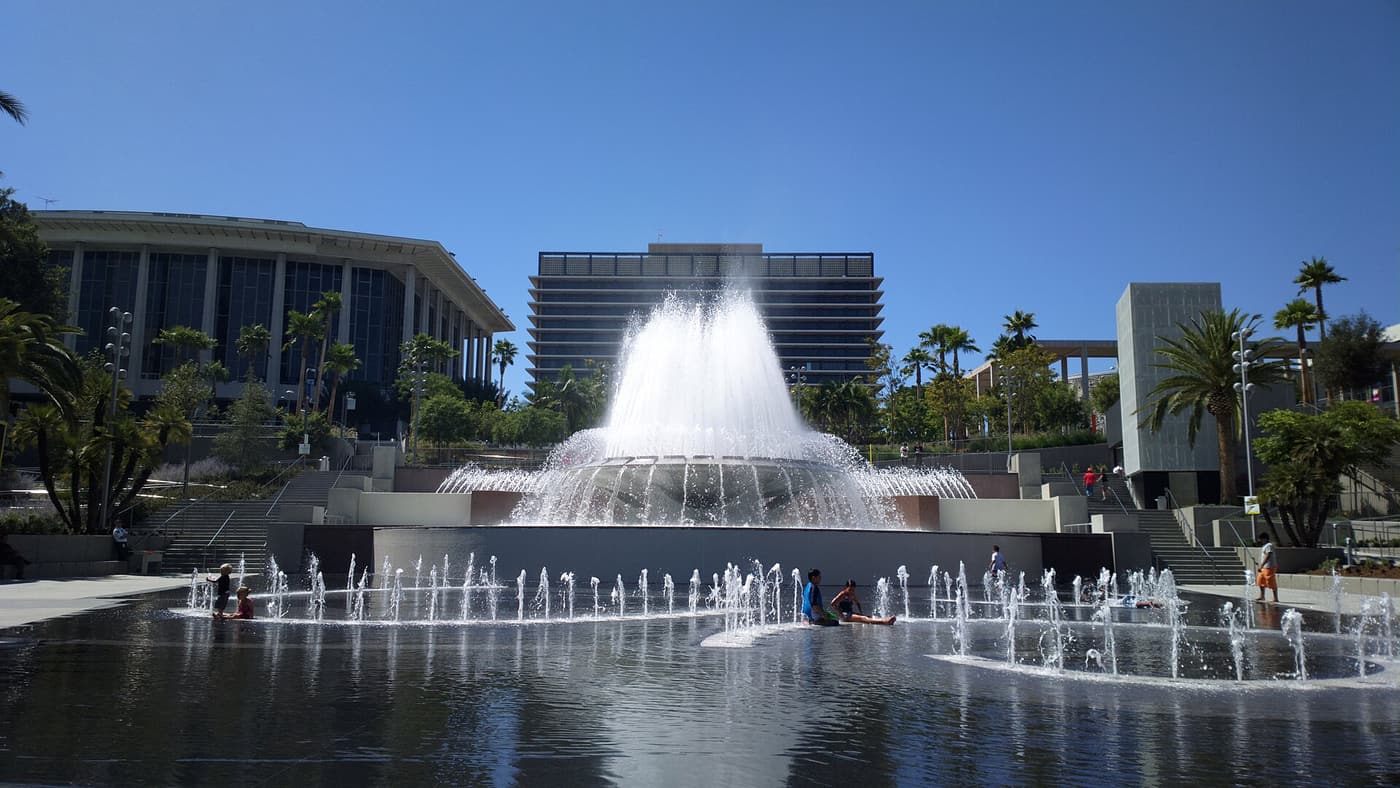
A twelve-acre linear park stretching from the to City Hall, designed to bring green space to the civic heart of downtown. The park's fountain — a splash pad that kids run through in summer — anchors the center, while the terraced lawns and pink benches offer a place to sit and watch the late-afternoon light hit the surrounding towers. On Independence Day the park often hosts community events, and the view back toward the San Gabriel Mountains from the upper lawn is one of the best sunset spots in the area.
A contemporary art museum housed in a striking honeycomb-veiled building designed by , opened in 2015. The collection holds over 2,000 postwar and contemporary works — , , , and Cindy Sherman among them — and the free general admission makes it one of the most accessible major art institutions in the country. The Infinity Mirror Rooms by Kusama are the big draw, though they require a separate timed ticket; the rest of the galleries are spacious, well-lit, and reward an unhurried walk. The museum stays open late on Saturdays, so the evening light through the building's filtered facade adds a soft glow to the upper galleries.
The Broad · Audio guideWeGoTripGeneral admission is free but requires an online reservation — these open on the museum's site a month ahead and go fast, especially on weekends. The need a separate timed ticket booked on top of the general entry; if those are gone, the rest of the collection is still worth the visit. Saturday evenings are less crowded than weekend afternoons, and the top-floor galleries have a view across Grand Avenue to the .
A little data on the walk over means we can pull up 's mobile guide at the door and check which galleries are open late — no hunting for a signal at the entrance. It also keeps the walking route from visible on the map, so the six-minute stroll is easy even as the streets get busier with evening crowds.
Get an eSIMAiralodoesn't allow large bags in the galleries, and after a full day walking from through , a backpack starts to feel heavy. Dropping it somewhere near before the museum means walking through the rooms hands-free, which is the whole point.
Store your bagsRadical Storage
 makes a personal plan in one tap. Tune it by mood, diet, time, budget, squad — and drop in your own places. Works in 65,000+ cities. It learns what you like, so every next plan fits better. Stop Searching. Start going.
Sources give mixed signals about this spot — we recommend confirming before visiting.
Tap outside to close
Tap outside to close
 squad
squad like
like