
📍 8 stops · ⏱ ~9.5 h

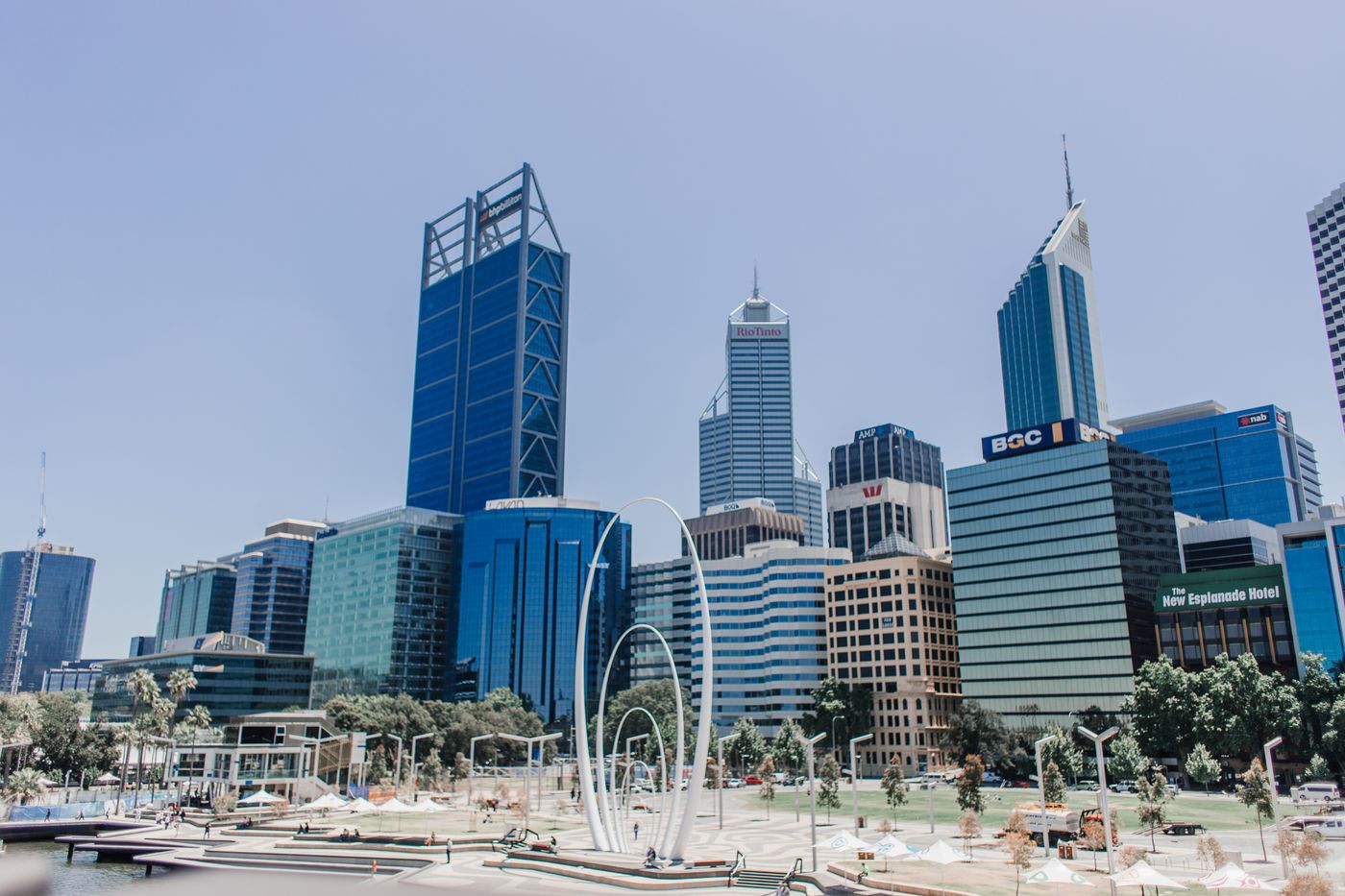
We spend the day walking through Perth's compact city centre, tracing its architectural layers from convict-built colonial stone to the ornate confidence of the gold-rush era and the streamlined elegance of interwar Art Deco. It's a route for anyone who likes reading a city through its buildings — government offices that started as Georgian barracks, a theatre that began as a picture palace, a fire station turned into a museum, and a cathedral that took over a century to finish. We move from the quiet dignity of the Treasury Buildings through the civic heart of the city, then cross the railway line into Northbridge for a different register of history altogether.
Want your own personalized plan for free?
is Perth's original high street, running along the ridge above the Swan River. In the late 19th century it was lined with the offices of wool brokers, shipping agents and mining companies — the administrative engine room of a colony that had just struck gold. Today glass towers loom over the few surviving stone facades, but the street still carries the same east-west axis it did when the first surveyors pegged it out in 1829. We'll start at the Barrack Street end, where the oldest government buildings cluster, and work our way west.
The Old Treasury Buildings on are among the finest surviving examples of convict-era colonial architecture in Perth. Built in stages from 1874, the complex housed the Treasury, the Lands Department and the Public Works Department — the three pillars of colonial administration. The pale stone, the deep verandahs and the symmetrical Georgian proportions were all designed to project order and permanence in a young settlement that badly needed both. Today the buildings house a hotel and restaurants, but the facades and the central courtyard remain largely intact, and you can still walk through the arched entrance on Barrack Street exactly as clerks did a hundred and forty years ago.
Walk all the way through the central courtyard to the Cathedral Avenue exit — it lets you out directly opposite the next stop, and the courtyard itself is a quiet pocket of stone and shade that most people on never see. The old lamp brackets on the walls are original gas fittings, converted to electricity sometime in the 1920s.
St George's Cathedral is a building that took its time. The foundation stone was laid in 1879, the nave was completed in 1888, and the tower wasn't finished until 1902 — by which point the original architect, , had been dead for nearly twenty years. The result is a Victorian Gothic church built from local red brick and Donnybrook sandstone, with a timber ceiling that soars above the nave in a way that feels unexpectedly light for a building of its era. It's still an active Anglican cathedral, and on a quiet Saturday morning the interior has the kind of hush that makes you lower your voice without thinking.
Right next to , is one of the few remaining examples of a mid-Victorian Gothic residence in Perth — built in 1859, it predates the cathedral itself by two decades. Together with the Old Treasury Buildings and the nearby , this cluster forms the densest concentration of 19th-century civic architecture in the city. It's worth pausing on the corner of Pier Street and St Georges Terrace to take in all three buildings at once: the cathedral's red brick, the Deanery's steep gables, and the Treasury's long stone arcade — three different registers of the same colonial project, all within a single city block.
The Supreme Court building on Barrack Street opened in 1903, right at the peak of Western Australia's gold-rush prosperity, and the building doesn't try to hide it. The facade is a confident mix of Federation Free Classical and Romanesque — heavy stone arches, a central tower, and a grand entrance portico that announces the law as something permanent and serious. The interior is open to the public during business hours, and the main courtroom upstairs has the kind of dark-wood panelling and high windows that make you feel like you've walked onto a period-film set.
His Majesty's Theatre opened on Christmas Eve 1904, and it's been operating ever since — making it one of the oldest continuously running theatres in Australia. The exterior is in the grand manner, but the real show is inside: a four-tier auditorium with a domed ceiling, ornate plasterwork and a horseshoe balcony that gives every seat a clear sightline to the stage. The building was designed by William Wolf, a Melbourne architect who specialised in theatres, and it shows in the backstage layout — the fly tower and dressing rooms were state-of-the-art for 1904 and still function well today. The theatre runs guided tours on Saturday mornings, but even if you just stand in the foyer and look up at the dome, it's worth the detour.
The theatre runs a backstage tour on Saturday mornings that takes you up into the fly tower and through the dressing rooms — book ahead on their website as places are limited.
Northbridge has always been the less buttoned-up sibling to the CBD. In the late 19th century it was the working-class quarter — warehouses, workshops, and cheap housing for the labourers who built the grand buildings on . By the mid-20th century it had become the city's immigrant neighbourhood, with Greek, Italian and Vietnamese communities opening cafes, groceries and restaurants. Today it's the cultural and nightlife hub: galleries, theatres, the State Library and the Western Australian Museum all cluster around the Cultural Centre, while William and James Streets hum with bars and restaurants. The architecture here is more eclectic than the CBD — you get Federation warehouses next to 1960s brutalist civic buildings next to 1990s postmodern additions — and that layered quality is exactly what makes it interesting.
The Western Australian Museum Boola Bardip reopened in 2020 after a major redevelopment that stitched together five existing heritage buildings with a striking new contemporary structure. The name Boola Bardip means 'many stories' in the Whadjuk Noongar language, and the museum's exhibitions range from the deep-time geology of the Pilbara to the social history of postwar migration. The heritage buildings themselves are part of the story — the Old Gaol, built in the 1850s, is now incorporated into the museum complex, and you can walk through the original cell blocks as part of the permanent display. The architecture is a conversation between old and new: convict-quarried limestone walls sit alongside glass and steel, and the central courtyard is a genuinely pleasant place to sit with a coffee between galleries.
WA Museum Boola Bardip · Book onlinevisit.museum.wa.gov.auDon't miss the Old Gaol section on the ground floor — the original 1850s limestone cells are still intact, complete with iron-bar doors and the narrow exercise yard. It's one of the oldest surviving structures in Perth, and the contrast between the rough-hewn convict stonework and the sleek new museum architecture around it is the most powerful architectural moment in the building.
The sits directly opposite the museum in the Cultural Centre, housed in a 1979 building that divides opinion sharply among locals. Inside, the permanent collection traces Western Australian art from the colonial period through to today, with a strong holding of works — the gallery has one of the most significant collections of Aboriginal and Torres Strait Islander art in the country. The temporary exhibitions programme brings in major touring shows, and the rooftop sculpture terrace offers an unexpected view back across the city. The gallery is free to enter for the permanent collection, making it an easy addition to any cultural day.
Art Gallery of Western Australia · Book onlineartgallery.wa.gov.auThe State Buildings on the corner of St Georges Terrace and Barrack Street are a masterclass in adaptive reuse. Originally built as the in 1923, the complex later housed the and the Titles Office — three separate government functions united under a single grand facade. The architecture is interwar Beaux-Arts with a distinctly Australian inflection: the pale Donnybrook sandstone, the copper-clad dome, and the colonnaded ground floor all speak to a city that had come of age and wanted the world to know it. In 2015 the entire complex was restored and converted into a hotel, restaurants and bars, but the public arcades through the ground floor remain open to anyone who wants to walk through. The central courtyard — originally a light well for the post office sorting room — is now one of the most atmospheric dining spaces in the city.
Inside the main entrance on St Georges Terrace, look for the original staircase that led up to the 's office. The wrought-iron balustrade and the timber handrail are original 1923 fittings, and the walls are lined with historic photographs showing the building in its working post-office days — mail sacks piled high in the very room where people now order cocktails.
From the State Buildings, Barrack Street slopes downhill toward the Swan River. At the bottom, the Bell Tower — a modern glass-and-copper spire built in 2000 — marks the edge of the water. The contrast between the 1920s sandstone of the State Buildings and the 21st-century glass of the Bell Tower, with the river glittering beyond, is a neat architectural summary of the day we've just walked: a city built in layers, each era leaving its mark on the next.
The Bell Tower is a deliberately contemporary punctuation mark at the foot of Barrack Street — a glass spire that houses the historic bells of St Martin-in-the-Fields, a gift from London to mark Australia's bicentenary in 1988. The tower opened in 2000 and its design, by local architects Hames Sharley, was controversial at the time: a sharp copper-and-glass needle rising from the river's edge, completely unlike anything else on the Perth skyline. Inside, the bells are rung regularly by a team of volunteer bell-ringers, and the observation deck offers a view back up Barrack Street that traces the exact route we've walked today.
The Bell Tower · TicketsTiqetsThe walk back up Barrack Street into the city is straightforward, but if we want to check what's on at the State Buildings' bars tonight or pull up the menu at one of the Northbridge restaurants we passed earlier, having a data connection on the phone makes that a ten-second job rather than a wander-and-hope. An eSIM for Australia loads in a minute before we set out and stays live all day.
Get an eSIMAiralo
 makes a personal plan in one tap. Tune it by mood, diet, time, budget, squad — and drop in your own places. Works in 65,000+ cities. It learns what you like, so every next plan fits better. Stop Searching. Start going.
Sources give mixed signals about this spot — we recommend confirming before visiting.
Tap outside to close
Tap outside to close

 squad
squad like
like