
📍 8 stops · ⏱ ~8 h

We spend the day threading through Perth’s layered history — from the gold-rush fortune that built its grandest institutions to the Gothic Revival spires and contemporary riverfront. The morning starts with a rare look inside the Mint, then moves through the city’s ecclesiastical and civic heart before a candlelit concert fills the Town Hall. Lunch is a modern Asian twist inside a government building, and the afternoon unwinds along the Swan River with bells, books, and a local farmers’ market.
Want your own personalized plan for free?
We start on , once the centre of Perth’s gold-boom wealth. The late-19th-century commercial buildings here still carry the confidence of a city that was suddenly flush — ornate facades, heavy cornices, and the sense that every bank wanted to out-build the next. sits just at the eastern edge of this strip, a low limestone compound that feels more like a fortress than a treasury.
Opened in 1899 during Western Australia’s great gold rush, the Mint is one of the oldest surviving buildings in the city and still operates as a working refinery. The limestone walls and wrought-iron gates were built to withstand attack — gold was poured, stamped, and stored here while the colony boomed. Inside, we can watch a live gold pour, see the world’s largest gold coin, and walk through the original vaults where fortunes were locked away. The building itself is a rare example of late-Victorian institutional architecture in Perth, designed by .
The live gold pour is the highlight here, and it runs on a set schedule — aim to be in the main hall a few minutes before the hour to get a spot near the front. The guide talks through the process while molten gold streams into a bar mould, and you can feel the heat from several rows back.
The guided tours fill up on Saturdays — booking ahead means we walk straight into the gold-pour demonstration without waiting.
Perth’s Catholic cathedral is a study in architectural layering — the original 1865 Gothic Revival structure was expanded in the 1920s and again in the early 2000s, each phase leaving its mark. The most striking addition is the modern glass-and-steel spire that rises above the old limestone nave, a controversial but now-beloved intervention that floods the interior with light. Inside, the stained glass tells the story of the diocese, and the timber ceiling of the original section still carries the scent of old jarrah. It is a working church, so Saturday mornings often catch the tail end of a wedding or the quiet before a vigil Mass.
The main entrance faces , not the street most people approach from. The quieter side door on the square’s edge lets you slip in without the tour-group bottleneck, and the view down the nave from that angle is the best first impression.
Built by convict labour in the 1860s and opened in 1870, the Town Hall is a Gothic Revival landmark with a distinctive clock tower that was for decades the tallest structure in the city. The interior is a soaring timber-and-brick hall with a hammerbeam roof modelled on English medieval guildhalls. It now hosts the concert series, where hundreds of LED candles fill the space and small ensembles play film scores and pop re-imaginings. A string quartet plays the Bridgerton soundtrack — classical covers of modern pop songs — in the candlelit main hall of the Town Hall. The setting transforms the room: the timber roof catches the flicker of hundreds of LED candles, and the acoustics of the old hall give the strings a warmth that a concert hall would not. The concert runs about an hour. Tickets are required and should be booked ahead — these Candlelight events routinely sell out on Saturdays.
The concerts sell out on weekends — grab tickets online before the day so we are not standing outside the disappointed.
Tucked into the lobby of , is a recent arrival that brings a bold, modern-Asian menu to the CBD. The room is bright and playful — tropical prints, pink neon, and a fit-out that feels more like a gallery than a government annexe. The share-plate menu moves through Vietnamese, Thai, and Korean influences: betel-leaf wraps, spicy tuna tostadas, and a standout caramelised pork belly. Lunch here is quick and lively, a sharp pivot from the morning’s old-world weight.
Light Years Perth · Book onlinesevenrooms.comThe menu is built for sharing, and the two dishes locals come back for are the betel-leaf wraps with smoked trout and the caramelised pork belly. Order both for the table and add a side of the turmeric roti — it is not on every table, but it should be.
is where the city meets the water — the ferry terminal, the , and a long promenade that stretches toward . On a Saturday afternoon, the square hums with families and ferry passengers, and the river opens up wide to the south. The light here in the early afternoon is sharp and clear, the water a deep blue against the pale limestone of the surrounding buildings.
The is one of Perth’s most distinctive modern landmarks — a glass-and-copper structure built in 2000 to house the bells of St Martin-in-the-Fields, a gift from London to mark Australia’s bicentenary. The twelve bells date from the 14th century and are among the oldest ringing peals in the world still in use. We can climb the tower for a panoramic view across the Swan River and back toward the CBD, and on Saturdays the bell-ringers often practise — the sound carries across the water. The architecture is deliberately nautical, the copper sail-like fins catching the afternoon sun.
The Bell Tower · TicketsTiqetsSaturdays often have a practice session around midday or early afternoon — if we hear the bells from outside, head up quickly to watch the ringers in action.
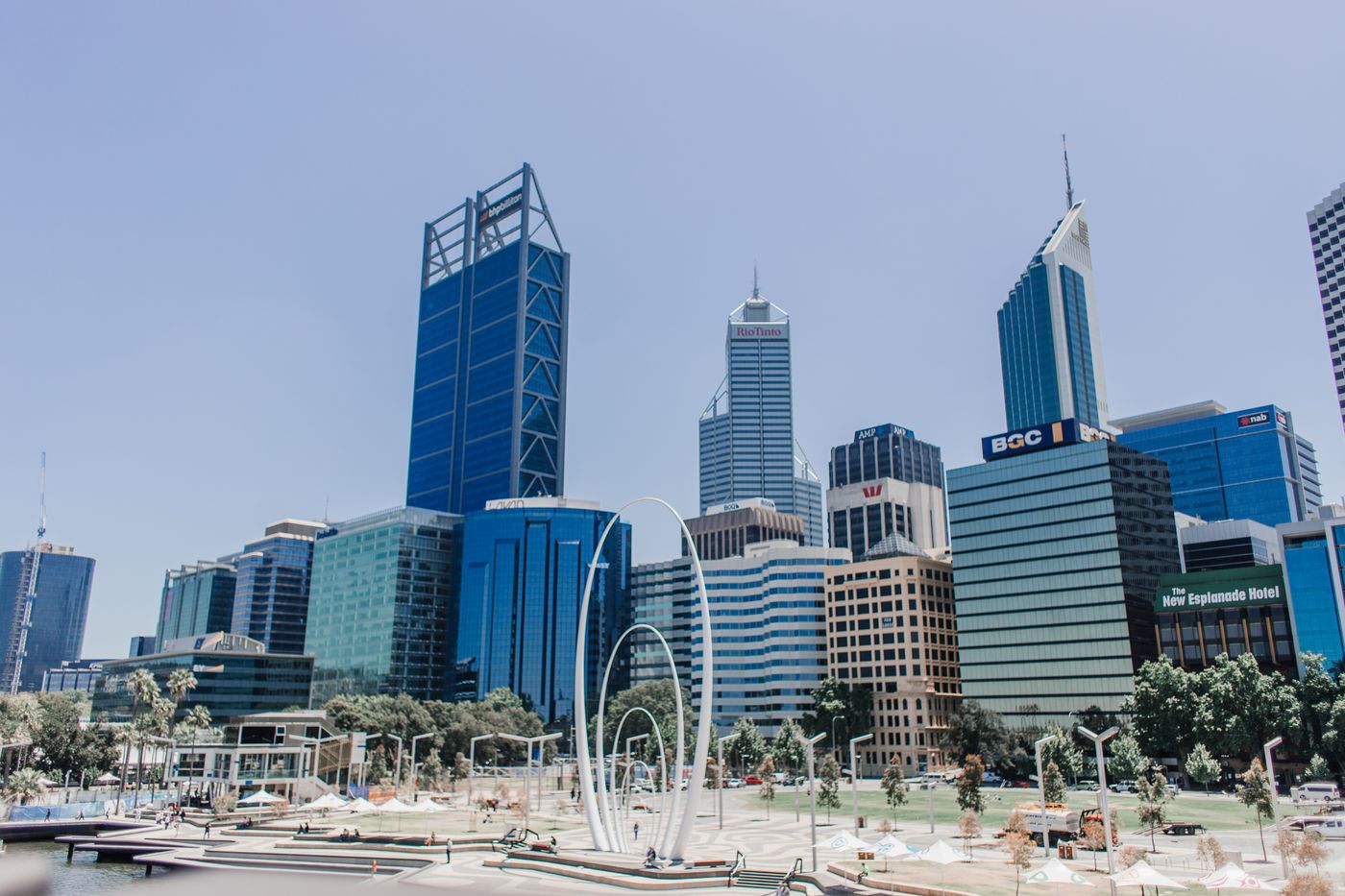
Elizabeth Quay is a contemporary waterfront precinct built around a man-made inlet of the Swan River. The centrepiece is the pedestrian bridge that arcs across the water, and the public art scattered throughout — including the large sculpture, a series of concentric rings that frame the sky. It is a good spot to pause and watch the ferries come in, with the city skyline rising behind us. On a clear afternoon, the water reflects the glass towers and the blue of the sky, and the breeze off the river keeps things cool.
Elizabeth Quay · Book onlinedevelopmentwa.com.auWalk halfway across the pedestrian bridge and turn back toward the city — that angle frames the Bell Tower, the river, and the skyline in one shot, and the bridge itself curves elegantly into the foreground.
Boffins Books is Perth’s specialist technical and non-fiction bookshop, tucked into a corner of the CBD on William Street. The shop has been here since 1989 and carries a deep selection of architecture, history, science, and art books — the kind of place where you walk in looking for one title and leave with three you did not know existed. The staff are famously knowledgeable, and the architecture section alone is worth the stop: local Western Australian building histories sit alongside international monographs. It is a quiet, serious bookshop in a city centre that has lost most of its independents.
The staff keep a shelf of Western Australian architecture and history titles behind the counter that are not always out on the floor — ask what they have on Perth’s gold-boom buildings.
Perth City Farm occupies a former scrap-metal yard turned community garden, a half-hectare oasis of raised beds, fruit trees, and recycled-material structures just east of the CBD. On Saturday afternoons the farmers’ market fills the central courtyard with local produce stalls, artisan bakers, and small-batch preserves. The vibe is relaxed and community-driven — families sprawl on the grass, volunteers tend the veggie patches, and the smell of fresh herbs and coffee drifts through the space. It is one of those places that reminds you Perth is still a small city at heart.
The Saturday farmers’ market at Perth City Farm is a weekly institution, running from the morning into the late afternoon. Local growers bring seasonal fruit and vegetables, and there are usually a handful of food stalls — wood-fired bread, fresh pastries, small-batch jams and honey, and a rotating cast of hot-food vendors. The market is set inside the farm’s garden, so we can wander the veggie beds between stalls and sit on the grass with whatever we pick up. It is the kind of market where the farmer who grew the carrots is the one handing them to you, and the whole operation runs on a gentle, unhurried rhythm.
The artisan baker here only brings a limited batch of sourdough and focaccia, and by late afternoon the best loaves are usually gone. If there is still a rosemary-and-sea-salt focaccia left, grab it — it is the best thing in the market.
sits just outside the main CBD grid — pulling up the market’s open days on the fly from the garden itself is the kind of small thing that keeps a long walking day smooth, especially if we want to double-check which stalls are still running as the afternoon winds down.
Get an eSIMAiralo
 makes a personal plan in one tap. Tune it by mood, diet, time, budget, squad — and drop in your own places. Works in 65,000+ cities. It learns what you like, so every next plan fits better. Stop Searching. Start going.
Sources give mixed signals about this spot — we recommend confirming before visiting.
Tap outside to close
Tap outside to close

 squad
squad like
like