
📍 8 stops · ⏱ ~7.5 h

We spend a full day walking through Ghent's medieval core and its art collections, moving from a guided history walk through the old port quays to the Ghent Altarpiece and the belfry, then crossing the river to the Museum of Fine Arts in the Citadelpark. The rhythm is a morning of storytelling and stone, a lunchtime pause among flea-market stalls, an afternoon of iconic views and flower-sellers, and a long early-evening stretch with Bosch, Rubens, and Magritte.
Want your own personalized plan for free?
A guided walking tour that covers the historical centre, tracing the city's rise from a medieval trading power to its later industrial chapters. The guide threads together the guildhalls, the fortress, and the cathedral quarter with stories of cloth, rebellion, and the river that made it all possible.
Ghent History Tour · TicketsViatorThe private tour runs with a local guide who adjusts the route to what interests the group most. Booking ahead is wise on a Saturday during the Ghent Festivities, when the centre fills up by midday.
The and are the two facing quays along the Leie river, lined with guildhalls that date from the 12th to the 17th centuries. The Graslei side is the grander one, with the stepped-gable and the ; the Korenlei across the water is narrower and quieter. During the Ghent Festivities the quays become a long open-air living room with music and food stalls, but even in a normal week this is where the city's pulse is most visible — boats loading, students sitting on the edge with their legs over the water, the light catching the brick gables in the late morning.
The and are the historic port quays of Ghent, lined with guildhalls and merchant houses that show the city's wealth during the Middle Ages. The architecture spans several centuries, with the narrow stepped-gable facades reflecting the tight plots and high taxes of the medieval port. Walk both sides to see the contrast: the Graslei is the showpiece, the Korenlei is where you find a quieter spot to sit and watch the boats.
Graslei and Korenlei · TicketsViator Things to do nearby Hidden Ghent: A Self-Guided Audio Tour Of The Flemish City
Viator
from €18
Hidden Ghent: A Self-Guided Audio Tour Of The Flemish City
Viator
from €18
The Saturday flea market spreads across the square in front of , a mix of antique furniture, old prints, vintage clothing, and bric-a-brac. It is less curated than the tourist-facing stalls elsewhere in the city; locals come here to rummage for records, glassware, and the occasional odd piece of silver. The church itself is worth a glance — a Romanesque core with later Gothic additions, often overlooked in favour of the bigger cathedrals.
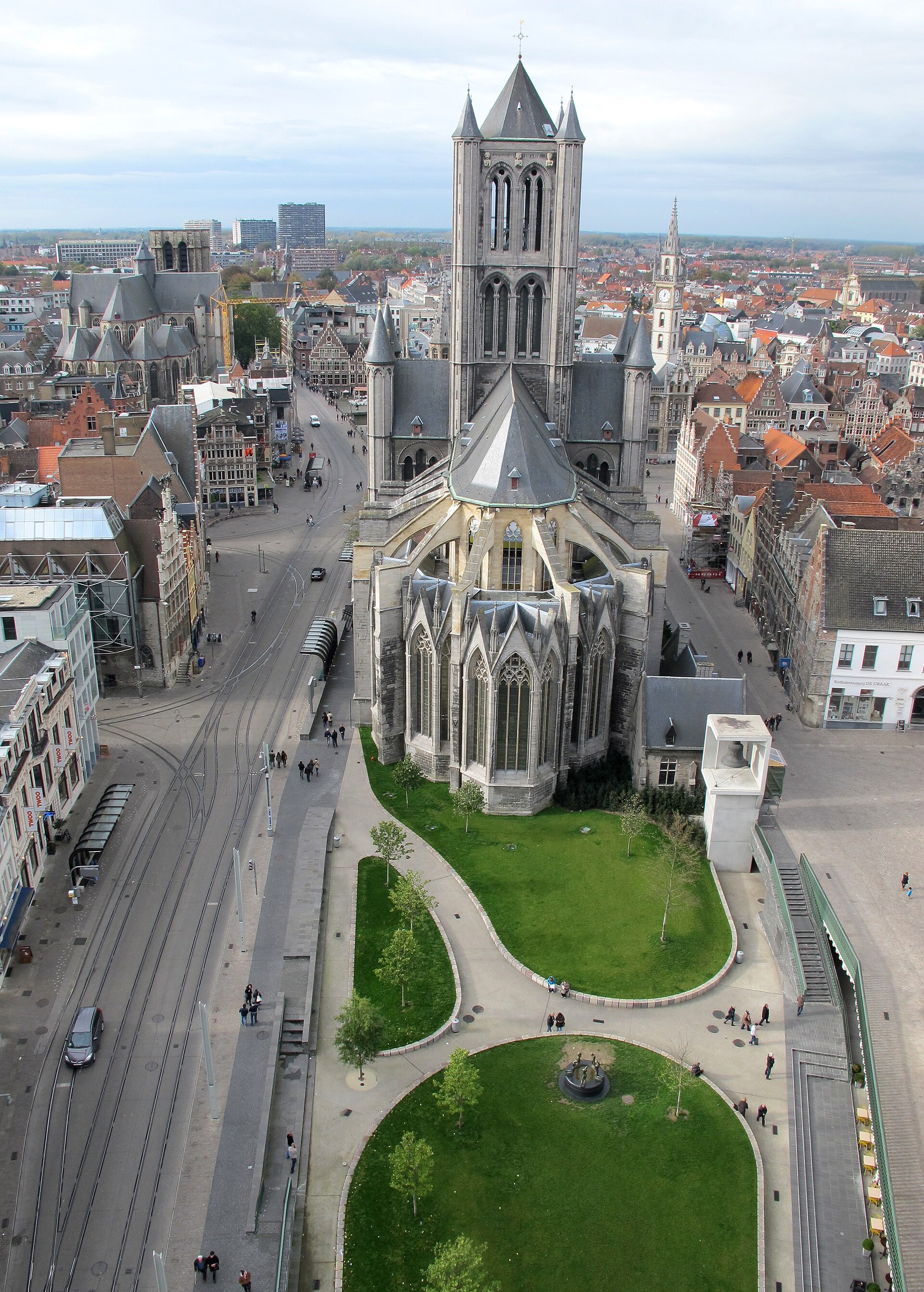
Sint-Baafsplein is the large open square in front of , framed by the cathedral's west tower on one side and the belfry and on the other. The square itself is a modern redesign with a shallow water feature, but the real interest is in the three architectural eras meeting here: the Romanesque and Gothic cathedral, the Gothic and Renaissance town hall just around the corner, and the belfry that has overseen the city since the 14th century.
houses the by , completed in 1432 and widely regarded as one of the most important paintings in European art history. The altarpiece sits in a dedicated chapel with controlled lighting and a separate admission ticket; the rest of the cathedral is free to enter and includes a altarpiece and a Baroque pulpit. The Van Eyck panels reward close looking: the detail in the Adoration of the Mystic Lamb panel, the botanical accuracy of the plants, and the way light falls across the figures.
St. Bavo's Cathedral · TicketsViatorEntry to the altarpiece chapel is separate from the cathedral itself and has timed slots. On a Saturday in July it is wise to book ahead; the last slot is usually mid-afternoon.
The belfry is a UNESCO-listed tower that has stood since the 14th century as the symbol of the city's civic independence. The climb is 91 metres up a narrow spiral staircase, passing the old dragon weathervane and the carillon room on the way. From the top the view stretches across the entire medieval centre: the three towers of , , and the belfry itself aligned, the quays visible to the west, and the green to the south.
Belfry of Ghent · TicketsViator's Bridge is the single best vantage point in the city centre, looking west along the Leie toward the and with the three towers rising behind. The bridge itself is a stone arch from the early 20th century, with a bronze statue of St. Michael at its centre. It is busiest at sunset, but in the mid-afternoon the light is still good and the crowds are thinner.
The Saturday on the is a long-standing local tradition, with stalls selling cut flowers, potted plants, and garden supplies arranged around the central bandstand. The square itself is elegant, lined with 19th-century townhouses and the old opera house at the southern end. Even without buying anything, walking through the rows of colour and the smell of fresh-cut stems is a quiet contrast to the stone and crowds of the centre.
The is a 19th-century English-style park laid out on the site of the old Dutch citadel, with winding paths, a small lake, and several museum buildings set among the trees. The sits at the eastern edge, a neoclassical building from 1904 that houses one of Belgium's most important collections. The park itself is a local favourite for an afternoon walk, and the approach to the museum through the greenery feels like stepping out of the medieval city into a different century.
The holds a collection that spans from the Middle Ages to the 20th century, with particular strengths in Flemish old masters and Belgian surrealism. Two panels by are among the highlights, alongside major works by , , and Jordaens. The modern wing includes Magritte and other Belgian surrealists, and the temporary exhibition programme often brings in strong international shows. The museum is large enough to fill a couple of hours without being overwhelming, and the galleries are well-lit and uncrowded compared to the more famous museums in Brussels and Antwerp.
The has a free digital guide accessible on your phone that walks through the highlights room by room. Having a data connection lets you pull it up at the entrance without hunting for Wi-Fi, so you can go straight in and start with the panels on the upper floor.
Get an eSIMAiraloThe is a long, absorbing visit — you do not want to do it with a daypack on your shoulder. There are luggage storage points near the station and in the centre where you can leave bags for a few hours, which means walking through the galleries with nothing but a phone and a coat.
Store your bagsRadical StorageThe viewing chapel has limited capacity and timed entry slots. On a Saturday in July, book your slot online before you arrive, ideally for early afternoon.
The is open until 18:00, and the last entry is usually 30 minutes before closing. Arriving by 17:00 gives a comfortable 90 minutes to see the highlights without rushing.
The belfry climb is 256 steps and the staircase is narrow; go before the afternoon rush. The carillon plays every 15 minutes, and being in the tower when it rings is a memorable few seconds of sound.
The flea market is a morning affair and starts winding down by early afternoon. Arriving around 13:00 gives enough time to browse before the stalls begin to pack up.
 makes a personal plan in one tap. Tune it by mood, diet, time, budget, squad — and drop in your own places. Works in 65,000+ cities. It learns what you like, so every next plan fits better. Stop Searching. Start going.
Sources give mixed signals about this spot — we recommend confirming before visiting.
Tap outside to close
Tap outside to close
 squad
squad like
like