
📍 8 stops · ⏱ ~7 h

A day built around eating and drinking your way through Liège — we start in the quiet of a Gothic church, then cross into the lively Carré grid, browse the riverfront market, taste house-brewed beer at the foot of the Bueren steps, climb those steps, wander the folklore-rich island of Outremeuse, settle in for a long Belgian dinner, and close the day browsing over 750 bottles in a specialist shop.
Want your own personalized plan for free?
A flamboyant Gothic church tucked just off the main shopping streets, built in the 16th century. The real draw is the interior: a riot of carved stone vaulting, a painted wooden ceiling that looks like lace, and stained glass that throws colour onto the floor even on an overcast morning. It is rarely crowded — most visitors walk straight past to the cathedral — which makes it one of the most peaceful corners of the city centre.
Things to do nearby Self Guided Secrets Tour in Namur and Miss Nothing
Viator
from €5
Self Guided Secrets Tour in Namur and Miss Nothing
Viator
from €5
On the outside wall of the church, look for the old flood-level marks carved into the stone. The Meuse used to rise right up to this spot before the canals were tamed. It is a small detail most people miss, but it gives you a sense of how much the river shaped life here.
By day, the Carré is a different animal: delivery vans, students heading to class, a few early drinkers at the zinc counters. The streets are tight, the buildings a mix of 18th-century brick and mid-century infill, and every third doorway leads to a bar. Walking through now, when it is nearly empty, you notice the details — the old painted signs, the wrought-iron balconies — that get swallowed by the crowd after 10 p.m.
A dense grid of pedestrian streets that has been the city's nightlife hub for decades. In the morning it is the best time for a coffee and a Liège waffle from a street-side counter — the waffles here are denser and chewier than the Brussels kind, studded with pearl sugar that caramelises on the iron. Grab one to eat as you walk, because the next stop is the riverfront market and you will want your hands free.
Le Carré · Book onlinele-carre.orgStretching along the Quai de la Batte on the Meuse's right bank, this is one of the oldest and largest markets in Belgium. On a Saturday morning the stalls are a cross-section of the city: cheese mongers with raw-milk Herve, fish stands with North Sea catch, rotisserie chickens dripping onto bread, and tables piled with produce from the Hesbaye farmland just west of the city. Even if you are not buying ingredients, the energy — the shouted prices in Walloon French, the clatter of crates — is the real draw.
Look for the stall selling boulets à la liégeoise — the city's signature meatballs in a sweet-sour sauce made with (a dark apple-pear syrup). They are sold by weight, hot from a bain-marie, and make a perfect snack to eat standing by the water. The syrup itself is also sold in tins; it keeps forever and is the one edible souvenir worth carrying home.
A small brewery and taproom tucked right at the foot of the Montagne de Bueren steps. They brew on-site — the copper tanks are visible through a glass wall — and the beer list changes with what is fresh. The house blonde is clean and crisp, a good counterpoint to the richer food. The kitchen does simple plates: charcuterie boards, croquettes, a solid steak-frites. Sit outside if you can; the terrace looks straight up at the staircase you are about to climb.
Brasserie C · Book onlinebrasseriec.comThe flight of four small pours lets you work through what is on tap without committing to a full glass of each. The staff know the beers inside out and will walk you through them if you ask.
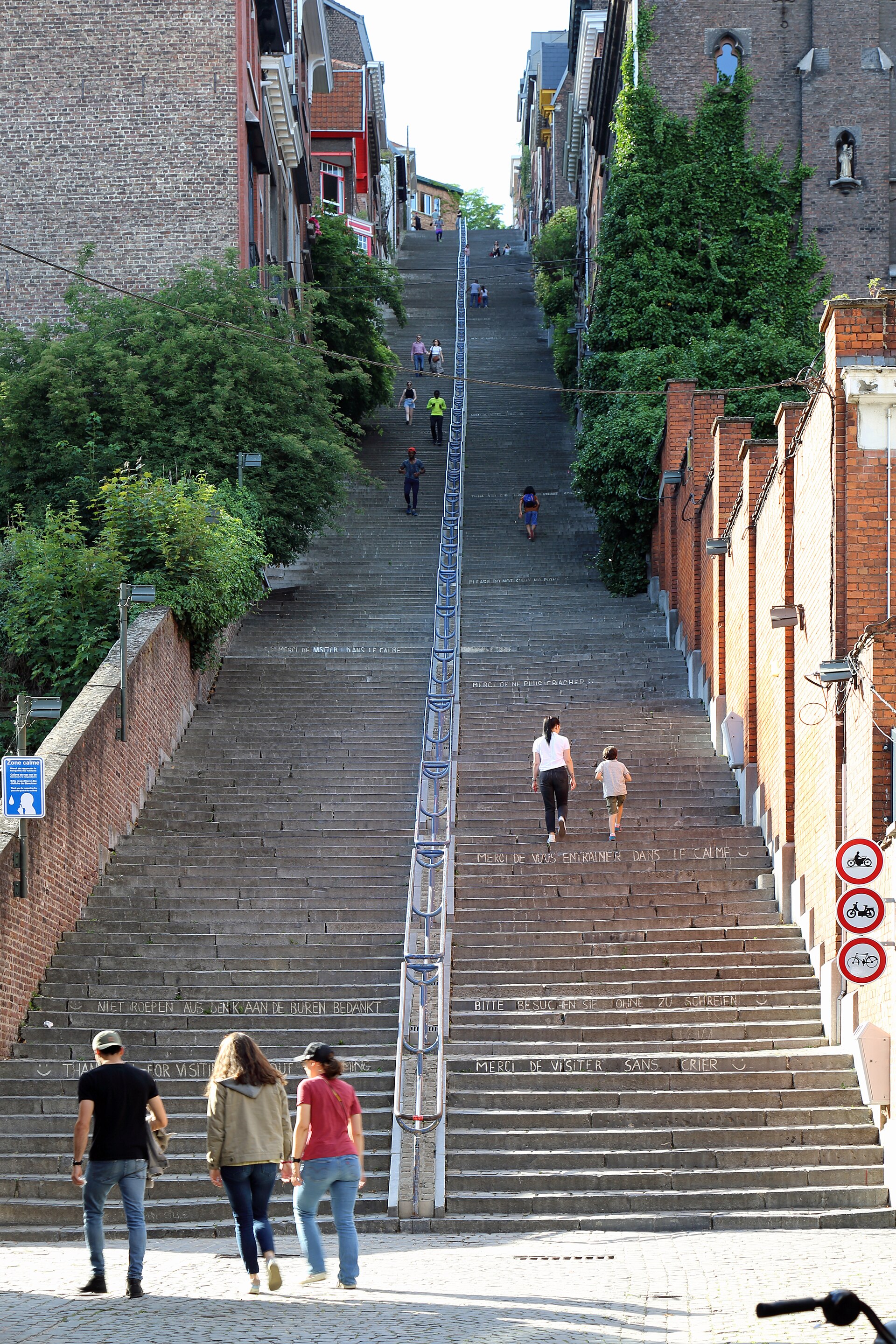
A staircase of 374 steps cut straight up the hillside, built in 1881 so soldiers could reach the citadel without walking through the red-light district below. It is steep — the incline hits nearly 30 percent — but the view from the top is the best in the city: the Meuse curling through the centre, the rooftops of the historic core, and on a clear day the hills of the Ardennes in the distance. Take it at your own pace; there are landings where you can stop and pretend to admire the view while catching your breath.
Outremeuse calls itself the République Libre — the Free Republic — and the joke is half-serious. This island has its own dialect, its own giant puppet (), and its own way of doing things. The streets are lined with modest brick houses, small squares, and the occasional mural celebrating local folklore. In the afternoon it is sleepy, the kind of place where old men play pétanque in the park and the cafés fill slowly around four.
Spend half an hour wandering the island's back streets. Duck into the courtyard of the if it is open — it is a tiny, eccentric museum dedicated to the neighbourhood's folklore puppet. Otherwise, just walk: the best stretch is along the Quai de l'Ourthe on the island's eastern edge, where the river bends and the light hits the water in the late afternoon.
A warm, wood-panelled Belgian restaurant near the Angleur station that locals treat as their extended dining room. The menu leans heavily on the classics: carbonnade flamande slow-cooked in beer, waterzooi with cream and herbs, and a formidable steak tartare prepared tableside. What sets it apart is the beer list — hundreds of bottles, many from small Walloon breweries you will not find elsewhere, and the staff can pair every dish with something unexpected. Book a table if you can; it fills up even on weeknights.
The staff here are walking encyclopedias of Belgian beer. Tell them what you usually drink and let them surprise you — the pairings are consistently better than picking from the menu yourself.
A specialist beer shop with over 750 bottles from across Belgium and beyond, run by people who treat beer the way a sommelier treats wine. The shelves are organised by style and region, and the staff will happily guide you through the Walloon section — saisons, tripels, and the rare Trappist ales that rarely leave the country. Even if you are not buying, it is a quiet, satisfying way to end a day built around food and drink: browsing the bottles, reading the labels, and planning what to open next time.
Look for anything from Brasserie de la Lesse or Brasserie des Légendes — small Walloon breweries whose bottles are hard to find outside the region. The shop also stocks the full range of with different ages; the six-month-old bottle drinks differently from the fresh one, and comparing them side by side is a quiet education in how beer evolves.
 A Liège Food Day: La Boverie to Guillemins, Markets, Waffles and Jazz
 From Prince-Bishops to the Meuse: a first-timer's walk through Liège's grand history and riverside life
 Liège in a day: fine art, Calatrava's station, waffles and the Bueren steps
 Liège's Essential Character: From Curtius to Boverie, a Day of Art, Views, and the Meuse
 makes a personal plan in one tap. Tune it by mood, diet, time, budget, squad — and drop in your own places. Works in 65,000+ cities. It learns what you like, so every next plan fits better. Stop Searching. Start going.
Sources give mixed signals about this spot — we recommend confirming before visiting.
Tap outside to close
Tap outside to close
 squad
squad like
like